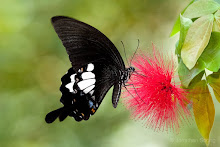
Monday, June 10, 2013

Common Tits by The Bay

I spent yesterday's morning out at Gardens by the Bay. Nestled right in the heart of Marina, it has a surprising number of butterflies.  While the weather swayed from unbearably hot to dark and windy multiple times, the butterflies were all out and about. The butterfly I encountered the most that morning was definitely the Common tit. This is a sunbathing male, revealing his spectacular upperside.


This charming lycaenid was seen mostly at the Meadow Car park. It is a common species and can be found in almost any locality, from urban parks to back- mangrove areas. The car park was planted heavily with many ornamental ixora flowers, the caterpillar host plants of the butterfly. I saw many of them feeding contently on the brilliant magenta blooms of the leea rubra shrubs planted alongside the ixoras.


There are two 'forms' of the common tit here, a grey one and an orange variant. This male veers towards the grey side, but there is a considerable amount of orange shading on the margin of the wings. The orange form has more pronounced shading. I did see many other species, but that would be for another time. It was brilliant to see all these butterflies taking sanctuary in the urban park and I will definitely be back.

Tuesday, June 4, 2013

Two weekends at Mandai (part two)

Today, following up to the previous post, I'll continue on my two trips to Mandai. My more recent visit saw a much smaller number of species, but it was interesting nonetheless. Early in the morning, with the sun still not penetrating the blanket of clouds overhead, the few butterflies I spotted were docile in the cool air. The highlight of the day was the first butterfly I shot, the rare Malay Staff Sergeant.

The Malay staff sergeant is said to be the island's most uncommon athyma species, but in more recent years it seems to have turned up more frequently. It was still a thrill to observe it as it fed greedily on the melastoma fruits. Countless lascar species were fluttering around the bush as well. This rather worn out specimen might be a Burmese lascar, another rarity.

Purple dukes were also abundant. They liked to dart rapidly out from under a leaf, fly around in circles then swoop back under another leaf. Both males and females were observed. This species, and the courtesan, are our sole representatives of the subfamily Apaturinae. The purple duke is a common sight in the forest, but is never easy to shoot. I believe this is a female. 

Once the sun was up in full force, many of the butterflies began to flee for shelter. However, the colonels seemed to enjoy the sweltering heat, chasing each other around in the treetops. Some even came down to feed on the remaining melastoma fruits. They were skittish were off at the slightest disturbance. Here is one of the more docile models, allowing me a few pictures before retreating to the trees.

Large and conspicuous butterflies aside, there were also many small blues out that day. The most numerous was the ever common acacia blue. I saw at least four of them fluttering around a single bush. Their stunning purple uppersides were a sight to behold. However, they only reveal them when sunbathing in the late afternoon. The underside is a  much more nondescript brown, with a few dark spots.


The real surprise was a tiny lycaenid I noticed flitting high up in a melastoma bush. When it flew down to a lower branch, it's identity was revealed- the semanga superba deliciosa. Yes, it is one of our most superbly delicious butterflies. With it's buff coloured underside adorned with patterns in red, blue, orange and black, it truly is a gem. All that colour- packed into something merely the size of a five-cents coin!


Though I have observed it many times before, it is always a joy to see. This one turned out to be my first sighting of a male, the much rarer sex. They are characterised by having a total of four tails on the hindwings. The females have six, and are usually larger.
Coming to the end, here is a male knight, one of my favourite forest species.


Well, I must say that these two days spent at Mandai have been two wonderful days of my life. The mere diversity of species there is astounding. But the fruiting season has come and gone, and all the butterflies would have gone back deep into the forest. Now I'm looking forward to participating in this survey, at Gardens by The Bay.

That's all for now. ;)

Monday, May 13, 2013

Two weekends at Mandai (part one)

Wow. It has been (quite literally) forever since I last put anything up here. Now that my mid-year exams are done with and out of the way, I thought I'd spend some time to rehydrate this place. For the past two weekends, I visited a lovely location nestled away in the Central Catchment area, and saw many exciting species. The highlight was this pristine male Courtesan. (pardon its name)

The courtesan seems to have established a healthy population there, and the place was sprawling with its caterpillar host plant, trema tomentosa. This fantastic blog article over at The Butterflies of Singapore talks about it in beautiful detail, while this earlier post gives a wonderful insight to its early stages. This male was very docile in the cool morning air. It had just rained. Many butterflies were feeding greedily on the ripe fruits of the melestoma bushes. Amongst them were Common Sailors and Chocolate Sailors:


These skittish neptis species were not the only ones enjoying the fruits. I was thrilled to see this beautiful Plain Plushblue fluttering amongst the bushes as well. This was a female, as her upperside was a shining purple. The male has a much deeper blue. However in both sexes, the plain brown undersides reflect lovely colours at different angles of light.


Better still, another plushblue turned up, the rare Shining Plushblue. This butterfly actually has Singapore in its Latin name "Flos fulgida singhapura". While it was not in the best condition, I was still happy to see it. It was territorial and constantly returned to its favourite bush even after I (accidentally) scared it off.


To finish off today's post, here is a pristine Yamfly. Yes, I seem to have an affinity with this species, and it appears to be very widespread in its distribution over the island. My shot shows the underside. The brilliant sunset orange upper is only revealed in the afternoon when they come out to sunbathe.


Okay, that is all for today; I shall post the rest of my sightings another day. I would also want to say an enormous Thank You! to all of my readers. Don't give up on this blog, don't. I promise to update it more frequently. Oh, and before I forget, I hope that the bigger pictures are an improvement. :)

Sunday, September 16, 2012

Gram blue

In the morning, I decided to have a quick walk to shoot some
butterflies. Because of the dull weather, not many butterflies
came out to play. But these gram blues came out in full force!!
These fellas are really hard to nail because of their non-stop flight.
Yup, they are also extreeemely wary and flutter off at the
slightest of movements.


They seemed to like to flit close to the ground, then land
and bask with their wings half-opened. The male topside (below)
has a brownish base colour, and is strongly shot with blue, giving
it a pale purple appearance. The female is mostly brown,
but has the basal areas (the areas closer to the body) a bright blue.


These lovely butterflies are actually pretty common in
Singapore, and they love to fly around open grasslands, where
the caterpillar host-plant, pueraria phaseoloides, grows
abundantly.

The End.

Sunday, September 2, 2012

Sightings from CCA

This morning I was out again with a few other ButterflyCircle
members explore some forest trails in the central catchment area.
What I wanted to go home with - the lesser harlequin. A small, rare
and beautifuuul butterfly. Yeah we didn't spot it. In fact we
hardly spotted anything. The first butterfly I saw was this little
Sixline-blue. He was actually feeding on the minerals deposited on
the leaf.


There were plenty of bush-browns fluttering among
the grasses too, chasing each other around. Much smaller are
the ypthima species. This fella is one of them, the Common four-rings.


This is a mating pair of Common five- rings.


The 'ring' butterflies are all extremely similar looking. Here
is an excellent article about our ypthima species and how the slight
differences tell them apart. The next thing spotted was the ever-
so-wary branded imperial. This male skipped across the trail and
showed me his topside.


After bashing through the trails but to no avail at all, we decided
to head back.This huge skipper suddenly landed heavily on a leaf
in front of me. Turned out it was a female Hoary Palmer. Sweet.


I made one wrong move and off it went, just as quickly as it
came. While searching for the palmer, I noticed a (much) smaller
something darting in and out of the undergrowth. When I peeked
under a leaf, a Plain banded awl was sitting patiently. 
It had such
wonderful glossy colours that were only visible with the flash-light.


Despite the low butterfly activities, it was still great to
get back out in the forests in a hit-and-miss quest to actually
see something new (to me, of course). And in the end I did see
a couple of new butterflies, making the trip pretty worthwhile.

The End. :)